Double emulsions (DEs) are highly structured fluids often described as "emulsions within emulsions," where a dispersed phase droplet contains even smaller internal droplets. This complex architecture features an intermediate layer (the shell) that acts as a shielding barrier, effectively isolating the inner droplets from the external continuous phase.
While water-in-oil-in-water (W/O/W) systems are more common, oil-in-water-in-oil (O/W/O) emulsions possess significant developmental value. They provide a unique pathway for:
Traditional bulk agitation methods often result in poor size control and low encapsulation efficiency. This application note demonstrates a one-step microfluidic method using a professional capillary-based workstation to produce highly uniform O/W/O double emulsions.
All solutions should be filtered using a 0.2 μm syringe filter.
Key Reagents: PVA, PGPR, MCT, and Octadecyltrimethoxysilane (for surface treatment).
The experiment utilizes the MF-3G series Droplet Microfluidics Workstation and the DUAL model capillary droplet microfluidic chip.
This workstation combines 3 intuitive syringe pump control with visualization system. It is an integrated solution for any lab wanting to adopt droplet microfluidics technology. It is perfect for many applications: particle generation, encapsulation, emulsions... and many more!
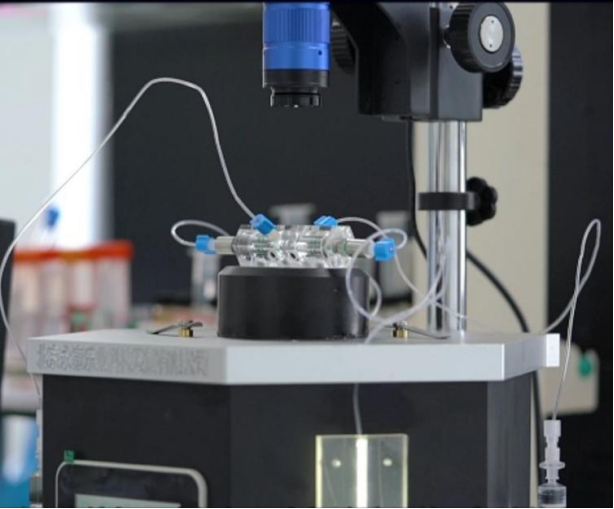
Figure 1. MF-3G Microfluidic Workstation.
The setup uses a DUAL model capillary droplet microfluidic chip. It is composed of fully removable parts: a hexagonal prism-shaped glass chip body with mounting holes, coaxially-aligned capillary tubes and capillary tube adjustment assemblies.The DUAL specific design allows for multiple liquid type emulsification within the same device. Note: The injection capillary of the DUAL chip requires hydrophobic treatment before use.
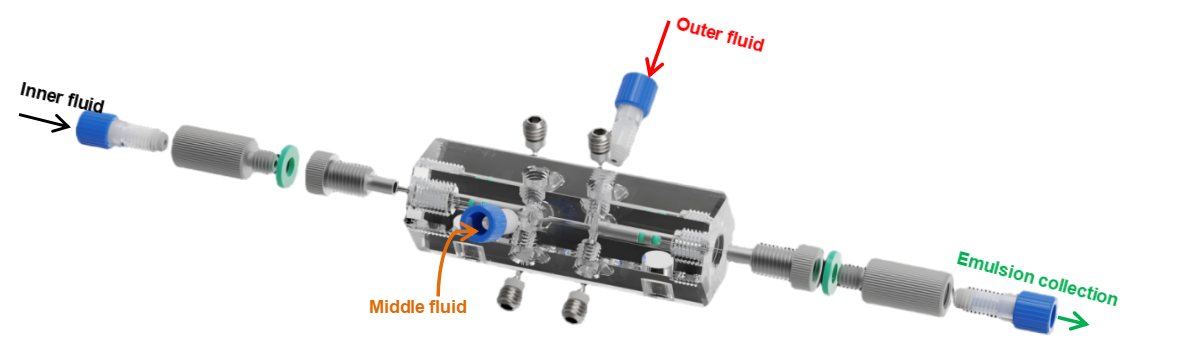
Figure 2. DUAL chip design
To prepare O/W/O emulsions, the extraction (collection) capillary must undergo hydrophobic treatment using octadecyltrimethoxysilane before chip assembly.
Load 10 mL syringes with the inner, middle, and outer phases and fix them to the workstation's syringe pumps.
Connect the syringes to the DUAL chip using PTFE tubing, Luer locks, and inverted cone joints to ensure a leak-proof system.
Submerge the outlet collection tube in the collection phase to ensure smooth entry for the generated droplets.
Start the Outer Phase first to fill the microchannels completely.
Once stable, start the Middle Phase to form a single emulsion.
Finally, start the Inner Phase to generate the O/W/O double emulsion.
Control the droplet size and the number of internal cores by adjusting the flow rates of the three phases. For example, stable generation can be achieved at flow rates of 15, 30, and 90 μl/min for the inner, middle, and outer phases, respectively.
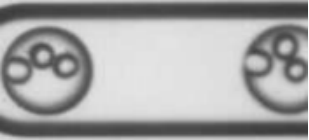
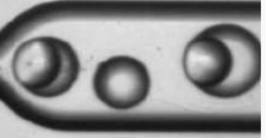
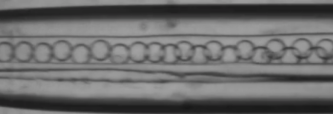
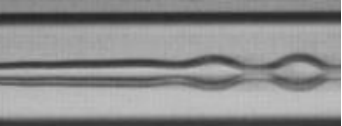
Real-time monitoring using a high-speed camera confirms the stable generation of monodisperse O/W/O double emulsions within the DUAL chip microchannels. Optical microscopy of the collected samples shows regularly spherical droplets with a clear "core-shell" structure and excellent dispersity.
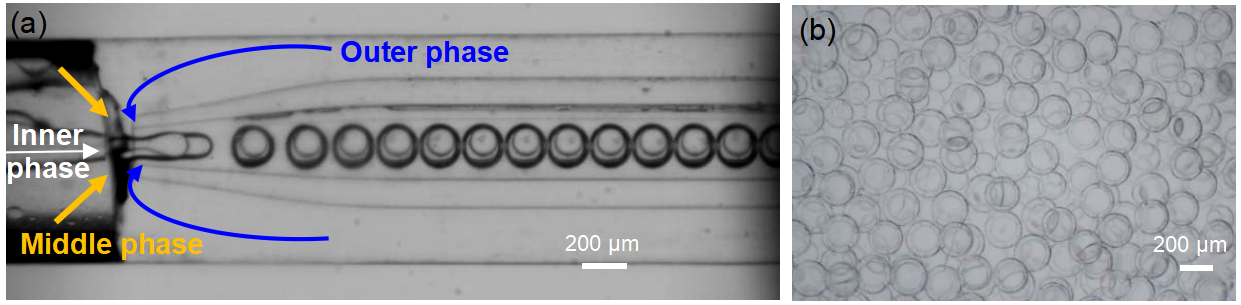
Figure 3. Stable generation of monodisperse O/W/O double emulsions. (a) Real-time generation of double emulsion droplets in the DUAL chip, with flow rates of the inner, middle, and outer phases being 15, 30, and 90 μl/min, respectively. (b) Optical microscope images of double emulsions obtained at the output.
KEY SUCCESS FACTORS & TROUBLESHOOTING
Successful double emulsion production relies on three critical factors: Capillary Coaxiality, Surface Modification, and Flow Rate Ratios.
1) Coaxial alignment of capillaries
Precise coaxial alignment ensures the formation of concentric laminar flow. Misalignment disrupts fluid symmetry, leading to uneven shear forces, non-uniform droplets, or total generation failure. Dual chip has a patented design that enables to position capillaries with flexible and precise coaxial alignment. More information about this chip can be found on our website.
2) Surface Modification
Since glass is naturally hydrophilic, the collection capillary must undergo hydrophobic treatment to allow the oil phase to wet the channel walls properly. This is essential for stable encapsulation in O/W/O systems.
3) Flow Rate Optimization
Outcome | Possible mitigation | |
"One-in-many" cores |
| Increase the middle phase flow rate until a stable "one-in-one" structure forms. |
Mixed single/double emulsions |
| Increase the inner phase flow rate. |
Jetting (Middle Phase) |
| Decrease the middle phase flow rate. |
Double Jetting |
| Reduce both flow rates simultaneously. |
1) Wang M., Xu Z., Huang X. Application and Research Progress of Double Emulsion Droplet Encapsulation Technology. Modern Chemical Industry, 2017.
2) Zhi Z., Liu R., et al. Recent progress in oil-in-water-in-oil (O/W/O) double emulsions. Crit Rev Food Sci Nutr. 2023.