
Core-shell microcapsules are specialized structures where the core and shell consist of different materials, allowing for the simultaneous encapsulation of synergistic drugs to enhance therapeutic efficiency and controlled release. While traditional microfluidic chips offer precision, they often face challenges such as complex fabrication and low reusability.
This application note demonstrates the use of a capillary microfluidic platform to overcome these hurdles. By employing a coaxial flow-focusing structure, the system ensures stable droplet generation, reduces wall-attachment effects, and allows for flexible adjustment of droplet morphology by simply changing capillaries. This study focuses on the fabrication of Polycaprolactone (PCL) microcapsules.
All solutions should be filtered using a 0.2 μm syringe filter.
This workstation combines intuitive syringe pump control with visualization system. It is an integrated solution for any lab wanting to adopt droplet microfluidics technology. It is perfect for many applications: particle generation, encapsulation, emulsions... and many more!
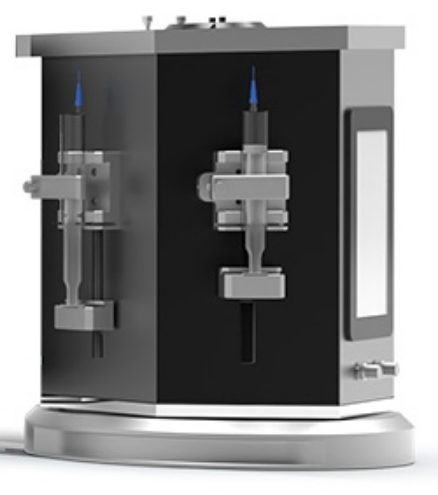
Figure 1. MF-3G Microfluidic Workstation.
The setup uses a DUAL model capillary droplet microfluidic chip. It is composed of fully removable parts: a hexagonal prism-shaped glass chip body with mounting holes, coaxially-aligned capillary tubes and capillary tube adjustment assemblies. The DUAL specific design allows for multiple liquid type emulsification within the same device. Note: The injection capillary of the DUAL chip requires hydrophobic treatment before use.
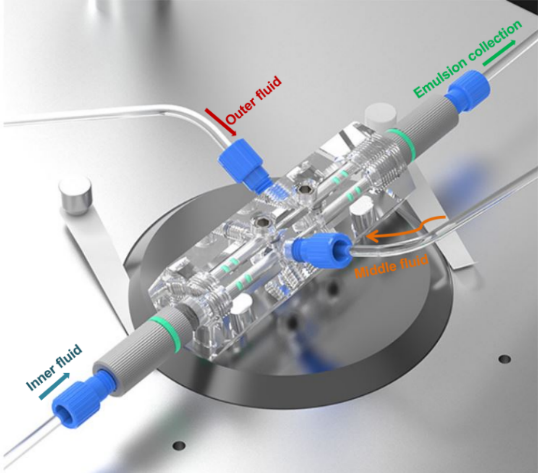
Figure 2. DUAL chip design
Load the inner, middle, and outer phase solutions into 10 mL syringes and fix them onto the workstation's syringe pumps. Connect syringes to the chip inlets via tubing. Add an appropriate amount of collection phase to a collection bottle, ensuring the outlet tube is submerged to facilitate smooth droplet entry.
Control the size and number of internal cores by adjusting the flow rates of the three phases. For example, stable double emulsions can be generated at flow rates of 38, 30, and 200 μl/min for the inner, middle, and outer phases, respectively.
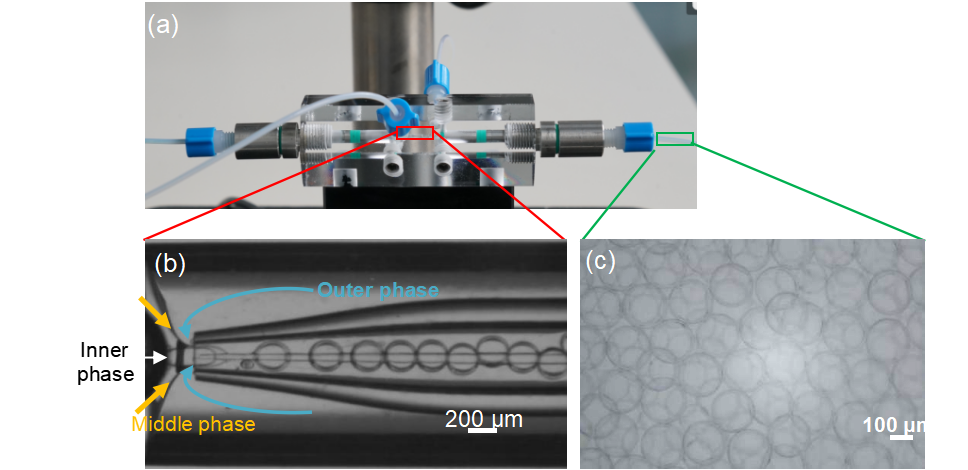
Figure 3. Double emulsion droplets formation within the DUAL chip. (a) Physical image of the DUAL chip; (b) Real-time generation of double emulsion droplets in the chip, with flow rates of the inner, middle, and outer phases being 38, 30, and 200 μl/min, respectively; (c) Optical microscope image of double emulsion droplets on a glass slide.
The collected double emulsions are kept in the collection bottle to allow the organic solvent (DCM) to evaporate, thereby solidifying the PCL shell into a stable core-shell structure. The solidified products are washed three times with pure water, separated, and then freeze-dried for characterization.
2) Characterization and Morphology
The freeze-dried microcapsules exhibit the following characteristics:
Size: The particles have a diameter of approximately 200 μm.
Shell Thickness: The PCL shell thickness ranges between 15 to 20 μm.
Surface Structure: SEM imaging reveals numerous micro-pores on the surface of the PCL shell, caused by the evaporation of DCM.
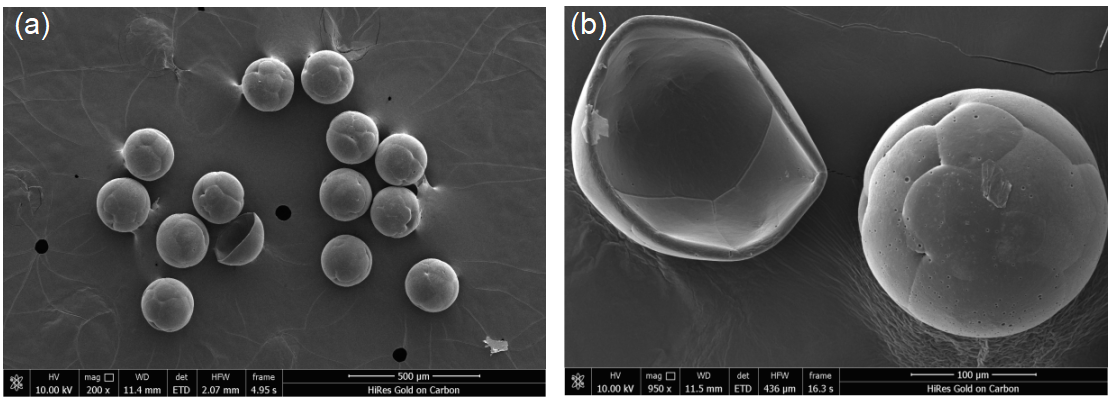
Figure 4. SEM images of the core-shell structure microparticles. (a) Surface morphology of the PCL microcapsules; (b) Cross section and surface details of the PCL microcapsules.
The droplet microfluidic workstation demonstrates professional capabilities in preparing W/O/W double emulsions, which is a core step in microcapsule production. This system provides a direct and effective method for producing core-shell composite microcapsules with uniform size, adjustable structure, and controllable release characteristics.
1) Duran, M., et al. "Microcapsule production by droplet microfluidics: A review from the material science approach." Materials & Design (2022).
2) Chen, Philipp W., R. M. Erb, and Studart, André R. "Designer Polymer-Based Microcapsules Made Using Microfluidics." Langmuir the Acs Journal of Surfaces & Colloids 28.1(2012):144.
3) Li, Y., Yan, D., Fu, F. et al. Composite core-shell microparticles from microfluidics for synergistic drug delivery. Sci. China Mater. 60, 543–553 (2017).