
Polystyrene (PS) microspheres are widely utilized in various high-precision fields, including the synthesis of ordered materials, biomedical testing, standard metrology, and as packing materials for chromatography columns. In recent years, monodisperse PS microspheres have increasingly been applied in the microelectronics sector, specifically serving as conductive particles within anisotropic conductive films.
Traditional methods often struggle with size uniformity. This application note demonstrates a sophisticated approach using capillary-based microfluidic chips to first generate oil-in-water (O/W) single emulsion droplets, which are subsequently solidified into high-quality PS microspheres via UV or thermal curing.
• Dispersed Phase (Oil Phase): A mixture of 20wt% Styrene and 75wt% Divinylbenzene (DVB), supplemented with 5wt% initiator.
• Continuous Phase (Aqueous Phase): 3.0 wt% PVA aqueous solution.
• Collection Phase: Same as the continuous phase.
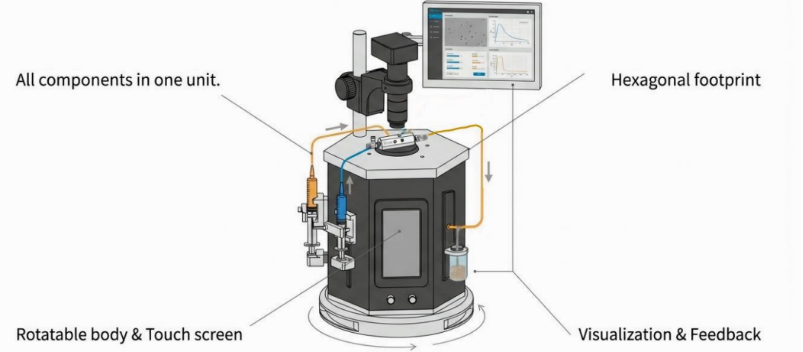
Figure 1. Scheme of the setup for PS microdroplets production
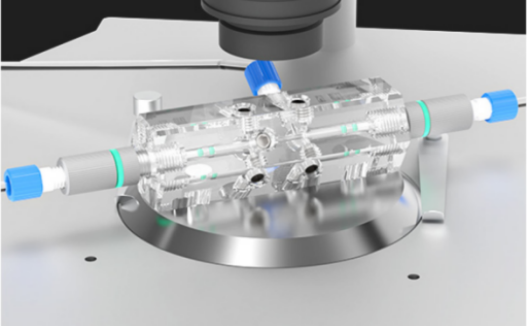
Figure 2. MONO chip design
The MONO chip is an assembled glass capillary microfluidic device for single droplet generation. It is composed of fully removable parts: a hexagonal prism-shaped glass chip body with mounting holes, coaxially-aligned capillary tubes and capillary tube adjustment assemblies.
The MONO specific design allows for single emulsions fabrication.
Load the dispersed phase (DP) and continuous phase (CP) solutions into separate 10 mL syringes and fix them onto the workstation's syringe pumps.
Use PTFE tubing to connect the syringes to the MONO chip inlets via Luer locks and inverted cone joints, ensuring the system is completely leak-proof. Add an appropriate amount of collection phase to a collection bottle, ensuring the outlet tube is submerged to facilitate smooth droplet entry.
Start continuous phase first at a low rate to wet channels. Then introduce dispersed phase. Continue both flows until all air bubbles are purged and steady flow is achieved. Adjust the flow rate ratio (CP:DP) to tune droplet size: higher flow rate ratio = Smaller droplets.
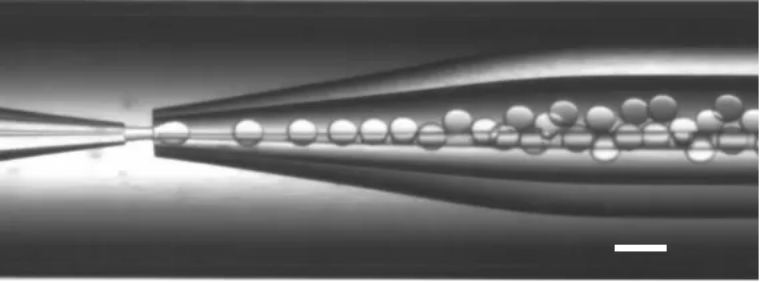
Figure 3. Polystyrene beads produced in MONO chip, the scale bar is 200μm.
The collected droplets are subjected to either UV light or heat (depending on the initiator used) to trigger polymerization, resulting in solid, monodisperse PS microspheres.
UV curing
The emulsion coming out of the droplet generating chip was collected into a 20 mL glass vial containing 10 mL of the continuous phase. The vial was subsequently exposed to the UV light for 0-20 min. The UV light source used has a wavelength of 365 nm and a light intensity of 3000 mW/cm², with the irradiation distance maintained between 1 and 2 cm. This process was tracked via optical microscopy, as shown in Figure 4.
Thermal curing
The emulsion coming out the chip was fed into a long PTFE tube providing a residence time of 15 min. The tube was immersed in a water bath and kept at a constant temperature of 80 °C.
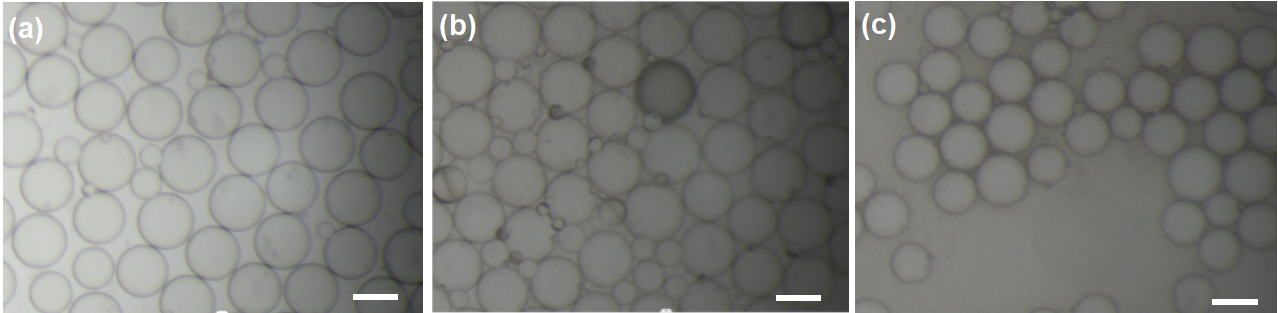
Figure 4. Curing morphology of microdroplets on a glass slide under different UV exposure durations. (a) 0 min of UV exposure; (b) 10 min of UV exposure; (c) 20 min of UV exposure. All scale bar is 100μm.
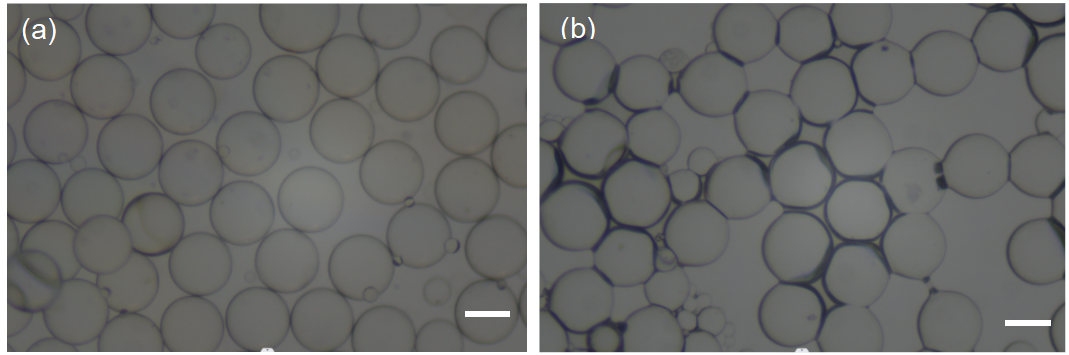
Figure 5. Morphology of microdroplets before (a) and after (b) heating. Scale bar: 80 μm.
1) https://www.dolomite-microfluidics.com/news/polystyrene-particles-synthesis/
2) Shevchenko, N., Svetlov, S. & Abiev, R. Continuous-flow microfluidic device for synthesis of cationic porous polystyrene microspheres as sorbents of p-xylene from physiological saline. J Flow Chem 11, 751–762 (2021). https://doi.org/10.1007/s41981-021-00142-9