Double emulsions (DEs) are highly structured fluids characterized as "emulsions within emulsions," where dispersed phase droplets contain even smaller droplets inside. In these systems, an intermediate layer (the shell) acts as a shielding barrier, effectively isolating the inner droplets from the external continuous phase1.
The most common types are water-in-oil-in-water (W/O/W) and oil-in-water-in-oil (O/W/O). These structures are vital across several high-precision industries:
This application note demonstrates a one-step microfluidic method to produce highly uniform W/O/W double emulsions using a professional capillary-based workstation.
All solutions should be filtered using a 0.2 μm syringe filter.
The experiment utilizes the MF-3G series Droplet Microfluidics Workstation and the DUAL model capillary droplet microfluidic chip.
This workstation combines 3 intuitive syringe pump control with visualization system. It is an integrated solution for any lab wanting to adopt droplet microfluidics technology. It is perfect for many applications: particle generation, encapsulation, emulsions... and many more!
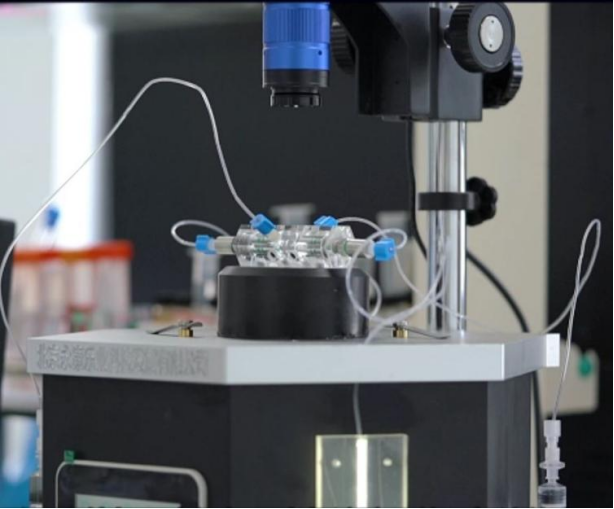
Figure 1. MF-3G Microfluidic Workstation.
The setup uses a DUAL model capillary droplet microfluidic chip. It is composed of fully removable parts: a hexagonal prism-shaped glass chip body with mounting holes, coaxially-aligned capillary tubes and capillary tube adjustment assemblies.The DUAL specific design allows for multiple liquid type emulsification within the same device. Note: The injection capillary of the DUAL chip requires hydrophobic treatment before use.
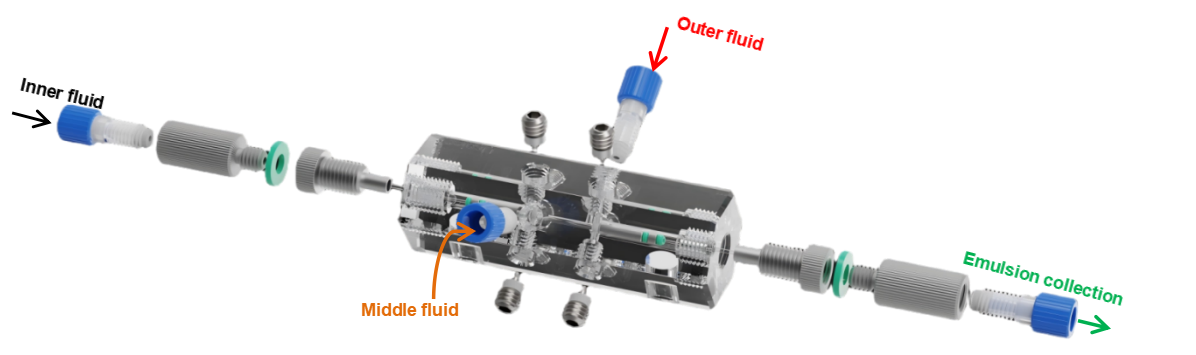
Figure 2. DUAL chip design
Before assembly, the injection capillary of the DUAL chip must undergo hydrophobic treatment using octadecyltrimethoxysilane.
Load the inner, middle and outer phase solutions into 10 mL syringes and secure them to the workstation's syringe pumps.
Use PTFE tubing to connect syringes to the DUAL chip via Luer and inverted cone joints, ensuring the system is leak-proof.
Submerge the outlet collection tube in the collection phase to ensure smooth entry for the generated droplets.
Set the flow rates on the workstation. The recommended sequence is:
Start the Outer Phase first to prime the channels.
Once stable, start the Middle Phase to form a single emulsion.
Finally, start the Inner Phase to generate the W/O/W double emulsion.
Adjust flow rates to control droplet size and the number of internal cores.
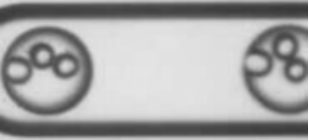
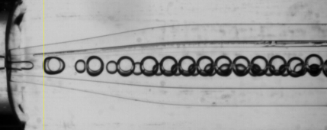
Stable generation of monodisperse W/O/W double emulsions was achieved in the DUAL chip. For instance, highly uniform droplets were produced at flow rates of 15 μL/min (Inner), 25 μL/min (Middle), and 60 μL/min (Outer). Optical microscopy confirms a clear "core-shell" structure with high size uniformity.
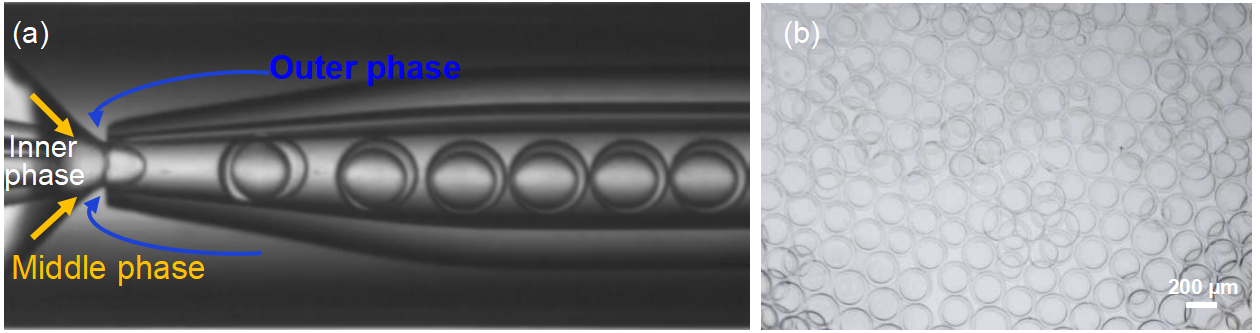
Figure 3. Stable generation of monodisperse W/O/W double emulsions. (a) Real-time generation of double emulsion droplets in the DUAL chip, with flow rates of the inner, middle, and outer phases being 12, 25, and 60 μl/min, respectively. (b) Optical microscope images of double emulsions obtained at the output.
Successful double emulsion production relies on three critical factors: Capillary Coaxiality, Surface Modification, and Flow Rate Ratios.
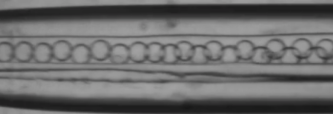
Precise coaxial alignment ensures the formation of concentric laminar flow. Misalignment disrupts fluid symmetry, leading to uneven shear forces, non-uniform droplets, or total generation failure.
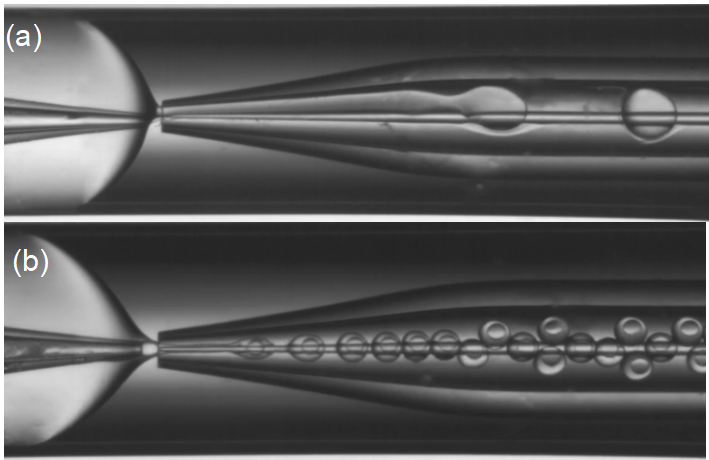
Figure 4. (a) Double emulsion formation with non-coaxial capillaries. (b) Double emulsion formation with coaxially aligned capillaries.
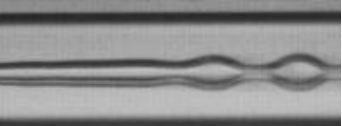
Since glass is naturally hydrophilic, the injection capillary must undergo hydrophobic treatment to allow the oil phase to wet the channel walls properly. This is essential for stable encapsulation in W/O/W systems.
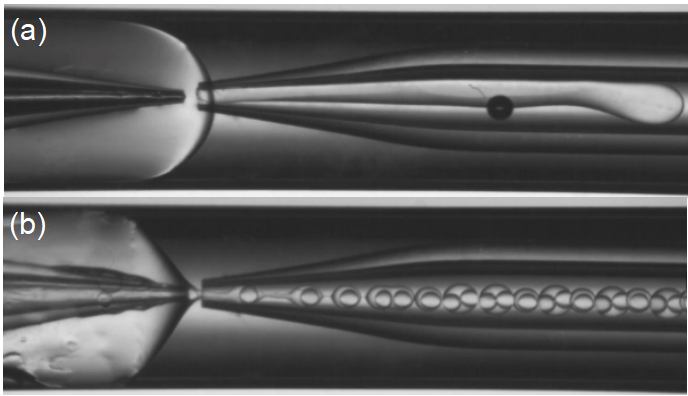
Figure 5. (a) W/O/W double emulsion formation with the injection capillary without hydrophobic treatment. (b) W/O/W double emulsion formation with the injection capillary after hydrophobic treatment.
Outcome | Possible mitigation | |
"One-in-many" cores |
| Increase the middle phase flow rate until a stable "one-in-one" structure forms. |
Mixed single/double emulsions |
| Increase the inner phase flow rate. |
Jetting (Middle Phase) |
| Decrease the middle phase flow rate. |
Double Jetting |
| Reduce both flow rates simultaneously. |
1) B. F. B. Silva, C. Rodríguez-Abreu, and N. Vilanova, ‘Recent advances in multiple emulsions and their application as templates’, Curr. Opin. Colloid Interface Sci., vol. 25, pp. 98–108, Oct. 2016.
2) U. Bazylińska, ‘Rationally designed double emulsion process for co-encapsulation of hybrid cargo in stealth nanocarriers’, Colloids Surfaces A Physicochem. Eng. Asp., vol. 532, pp. 476–482, Nov. 2017.
3) X. Qi, L. Wang, and J. Zhu, ‘Water-in-oil-in-water double emulsions: An excellent delivery system for improving the oral bioavailability of pidotimod in rats’, J. Pharm. Sci., vol. 100, no. 6, pp. 2203–2211, 2011.
4) N. P. Aditya, S. Aditya, H. Yang, H. W. Kim, S. O. Park, and S. Ko, ‘Co-delivery of hydrophobic curcumin and hydrophilic catechin by a water-in-oil-in-water double emulsion’, Food Chem., vol. 173, pp. 7–13, Apr. 2015.
5) R. Shaddel, J. Hesari, S. Azadmard-Damirchi, H. Hamishehkar, B. Fathi-Achachlouei, and Q. Huang, ‘Double emulsion followed by complex coacervation as a promising method for protection of black raspberry anthocyanins’, Food Hydrocoll., vol. 77, pp. 803–816, Apr. 2018.