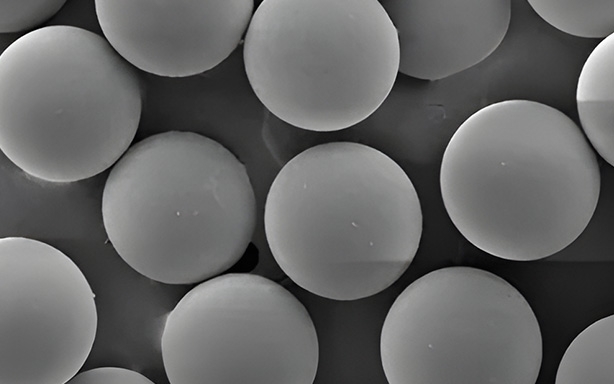
Size: 25-200 μm
Our Poly(ε-caprolactone) (PCL) microspheres are high-performance, biodegradable polymer particles. Due to their advantageous viscoelastic and rheological properties, PCL has been approved by the U.S. Food and Drug Administration (FDA) for human use. These microspheres offer a slow degradation rate, making them a premier choice for long-term implantable devices and sustained-release applications.
Key Features
•Monodispersity: Precise and controllable particle size with a narrow distribution.
•Safety & Compliance: FDA-approved material, inherently safe with no specialized detoxification required.
•Versatile Loading: Capable of encapsulating proteins, peptides, vaccines, and various small-molecule drugs.
•Customization Services: Custom options available for particle size, fluorescence labeling, and surface functionalization to meet specific research needs.
Applications
•Drug Delivery: Enhancing bioavailability and enabling controlled/targeted release of APIs.
•Tissue Engineering: Serving as scaffolds for cell seeding and carrying bioactive molecules to facilitate tissue repair and regeneration.
•Bioimaging & Theranostics: Integration with contrast agents or fluorescent markers for CT, MRI, and optical imaging.
•Medical Aesthetics: Used in dermal fillers to smooth skin surfaces, reduce wrinkles, and correct facial contours.
Product Specifications
•Product Form: Lyophilized (Freeze-dried) powder.
•Packaging: High-quality glass vials.
•Storage: Store at room temperature or refrigerated (2-8°C) in a dry, light-protected environment.
Material | Average Particle Size | Intrinsic Viscosity | Packaging Specification |
Poly(ε-caprolactone) (PCL) | 25 μm | 0.4 dl/g | 50 mg |
Poly(ε-caprolactone) (PCL) | 50 μm | 0.4 dl/g | 50 mg |
Poly(ε-caprolactone) (PCL) | 100 μm | 0.4 dl/g | 50 mg |
Poly(ε-caprolactone) (PCL) | 200 μm | 0.4 dl/g | 50 mg |
Poly(ε-caprolactone) (PCL) | 25 μm | 0.8 dl/g | 50 mg |
Poly(ε-caprolactone) (PCL) | 50 μm | 0.8 dl/g | 50 mg |
Poly(ε-caprolactone) (PCL) | 100 μm | 0.8 dl/g | 50 mg |
Poly(ε-caprolactone) (PCL) | 200 μm | 0.8 dl/g | 50 mg |
Poly(ε-caprolactone) (PCL) | 25 μm | 1.2 dl/g | 50 mg |
Poly(ε-caprolactone) (PCL) | 50 μm | 1.2 dl/g | 50 mg |
Poly(ε-caprolactone) (PCL) | 100 μm | 1.2 dl/g | 50 mg |
Poly(ε-caprolactone) (PCL) | 200 μm | 1.2 dl/g | 50 mg |
Poly(ε-caprolactone) (PCL) | 25 μm | 1.7 dl/g | 50 mg |
Poly(ε-caprolactone) (PCL) | 50 μm | 1.7 dl/g | 50 mg |
Poly(ε-caprolactone) (PCL) | 100 μm | 1.7 dl/g | 50 mg |
Poly(ε-caprolactone) (PCL) | 200 μm | 1.7 dl/g | 50 mg |
Note: For research use only.
Custom particle sizes and molecular weights are available upon request.
Resuspension Protocol
To ensure optimal performance, follow these steps to resuspend the lyophilized PCL microspheres in an aqueous medium (e.g., deionized water or buffer):
Retrieval: Remove the vial from storage.
•Equilibration: Allow the vial to reach room temperature before opening.
•Solvent Addition: Add the required volume of deionized water or buffer.
•Vortexing: Use a vortex mixer to ensure the microspheres are uniformly dispersed.
•Ultrasonication: Place in an ultrasonic bath for 5 minutes to break up any potential aggregates.
•Inspection: Verify the suspension is uniform and free of visible clusters.
References
1.Thakur, M.; et al. Poly (ε‐caprolactone): A potential polymer for biodegradable food packaging applications. Packaging Technology and Science. 2021, 34(8): 449-461.
If you want to learn more about product information
Please fill in the following information to download the product manual. We will reply to you as soon as we receive your message.