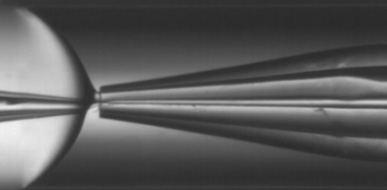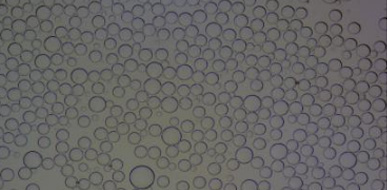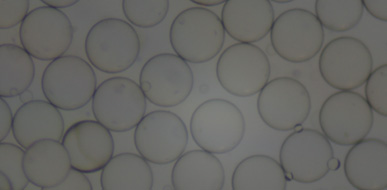


On the premise that the chip and the composition of each phase fluid are determined, the particle size of the droplets is mainly affected by the flow rate of the liquid phase.
Taking double emulsion droplets as an example: the size is mainly adjusted by the flow rate ratio of the outer phase to the sum of the middle phase and inner phase (outer phase/(middle phase + inner phase)). The higher the flow rate ratio of the two phases, the more it tends to generate small-sized droplets; conversely, it is more conducive to the generation of large-sized droplets, where the size mentioned here refers to the overall size of the droplets.
In fact, the particle size of a double emulsion involves the size of the inner core droplet, the size of the outer droplet, and the shell thickness (the size difference between the two droplets).
With the flow rates of the outer phase and middle phase fixed, within a certain range of inner phase flow rate, the higher the flow rate, the larger the size of the inner core droplet, which means the shell thickness of the prepared double emulsion droplets decreases. With the flow rates of the outer phase and inner phase fixed, within a certain range of middle phase flow rate, the higher the flow rate, the larger the size of the outer droplet, which means the shell thickness of the prepared double emulsion droplets increases.