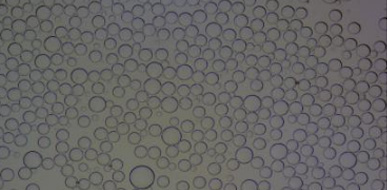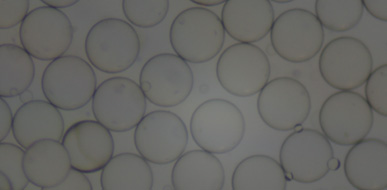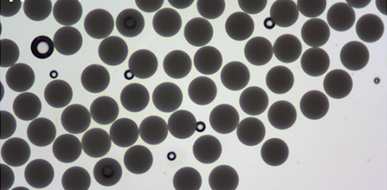


The key critical factors for the preparation of double emulsions include: the coaxiality of capillaries, the hydrophilic and hydrophobic modification of capillaries, and the appropriate flow rate ratio. Among them, the first two factors are the most critical.
1. Coaxiality of Capillaries
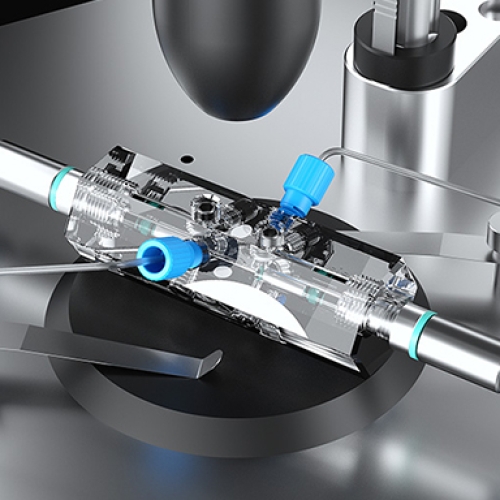
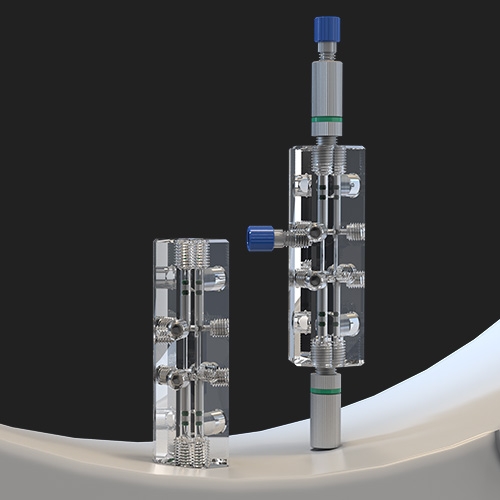
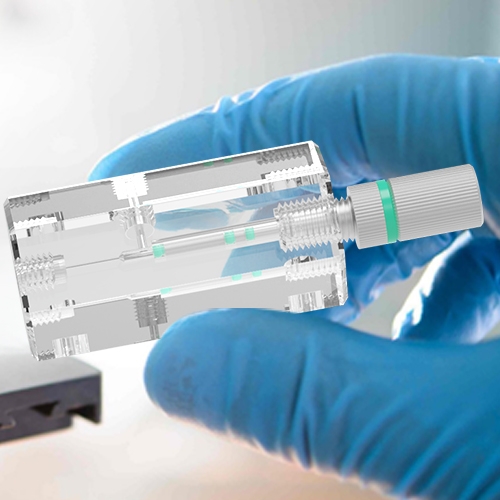
Precise three-dimensional coaxial alignment of capillaries is the prerequisite for stable and efficient preparation of double emulsions. The DUAL droplet microfluidic chip features a hexagonal prism appearance, a capillary angle adjustment mechanism, and a transparent glass material. The combination of these three features enables multi-faceted rotation, observation and fine adjustment, ensuring precise three-dimensional coaxial alignment. For more assistance, please consult our technical personnel.
2. Hydrophilic and Hydrophobic Modification of Capillaries
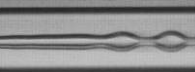
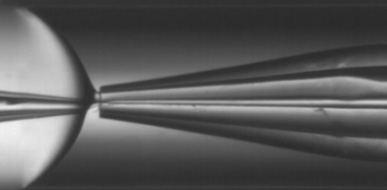
Glass itself has inherent hydrophilicity. To achieve stable generation of water-in-oil (W/O) droplets, it is usually necessary to perform hydrophobic modification on the channels through which the oil phase flows, so that the inner wall of the channels is more easily wetted by the oil phase. For the preparation of water-in-oil-in-water (W/O/W) double emulsions,hydrophobic treatment is generally performed on the inlet capillary. For the preparation of oil-in-water-in-oil (O/W/O) double emulsions, hydrophobic treatment is generally performed on the collection capillary. The following figure shows the comparison of the preparation state before and after hydrophobic treatment of the inlet capillary during the preparation of W/O/W double emulsions.
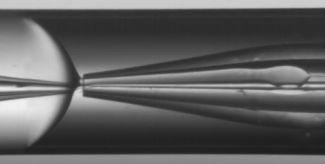
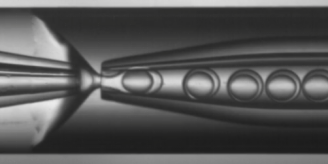
Inlet capillary without hydrophobic treatment Real-time state of double emulsion preparation after hydrophobic treatment of the inlet capillary
It can be seen that after the inlet capillary is subjected to hydrophobic treatment (right figure), the fluids converge at the inlet of the collection capillary, forming a layered and coaxial two-phase jet, which breaks up to generate double emulsion droplets.
3. Appropriate Flow Rate Ratio
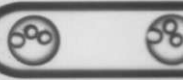
• Occurrence of "one outer droplet encapsulating multiple inner cores": This situation usually occurs when the flow rate of the middle phase is relatively higher than that of the inner phase, while the flow rates of the two phases are not significantly different, and the droplet breakup frequency of the inner phase is faster than that of the middle phase. At this time, the flow rate of the middle phase can be appropriately increased until stable "one outer droplet encapsulating one inner core" double emulsion droplets are formed at a certain flow rate value.
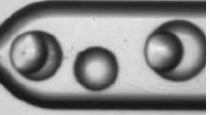
• Occurrence of single emulsion droplets mixed with double emulsion droplets: At this time, the flow rate of the inner phase should be adjusted and increased appropriately.
• Occurrence of jetting of the middle phase mixed with inner core droplets: The reason for the jetting of the middle phase is that its flow rate is excessively high, and it is sheared by the outer phase fluid to form a thin liquid streamline. At this time, the flow rate of the middle phase should be appropriately reduced.
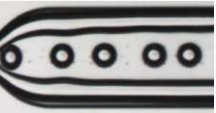
• Occurrence of simultaneous jetting of the inner phase and the middle phase: This indicates that the flow rates of both the inner phase and the middle phase are excessively high. At this time, the flow rates of the two phases should be reduced simultaneously, and then the flow rate of each phase should be adjusted appropriately according to other subsequent conditions.