

The microfluidic flow control system is a critical component in the development and operation of any microfluidic device. It enables the precise manipulation and delivery of small volumes of liquid, thus supporting a wide range of applications including pharmaceutical research, lab-on-a-chip systems, and point-of-care diagnostics. The most widely used microfluidic flow control systems are pressure-driven pumps, syringe pumps, and peristaltic pumps.
Pressure-driven Pumps
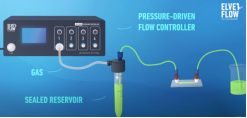
For pressure-driven pumps, fluid delivery is controlled by adjusting the applied pressure. Typically, the target fluid is held in a sealed reservoir, pressurized by the air above it, and delivered into the microfluidic channel. Prior to injecting the sample into the microfluidic chip, the sample can be stirred within the reservoir to prevent sedimentation, while temperature control is easily implemented, and large sample volumes of up to several liters can be accommodated. Pressure-driven pumping has an extremely short response time of around tens of milliseconds, and is highly suitable for pumping high-viscosity fluids. However, the main drawback of pressure-driven pumps is that they require a flow control unit, which increases the overall cost of the system.
Syringe Pumps
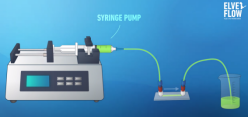
Syringe pumps are the most commonly used fluid delivery systems in microfluidics. They drive the plunger of a syringe at a fixed rate via a stepper motor. Their greatest advantage is ease of use, with no specialized or complex operations required. In contrast to pressure-driven pumps, syringe pumps regulate flow by varying the flow rate directly rather than pressure, eliminating the need for a flow meter for flow control. Most syringe pumps are equipped with a built-in library of syringe types and volumes. Once the syringe is selected, the pump automatically calculates the cross-sectional area of the syringe and the speed at which the syringe plunger must be advanced to deliver the required flow rate. Syringe pumps support configurations from single-syringe to multi-channel setups, enabling the delivery of multiple reagents simultaneously. With a programmable syringe pump, users can go beyond simple infusion and withdrawal operations to create customized pumping protocols consisting of flow profiles ranging from simple to complex. However, syringe pumps may have a slow response time. In addition, the dispensed volume of the solution is limited by the size of the syringe, making them unsuitable for long-term experiments.
Peristaltic Pumps
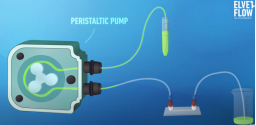
Peristaltic pumps are versatile, highly efficient, and reliable pumps. They apply pressure to the fluid inside a hose within the pump head, squeezing it through the length of the tubing and controlling its flow rate. This makes peristaltic pumps highly suitable for applications such as the dispensing, metering, and transfer of small volumes of liquid. They are also an ideal solution for long-term experiments, as they can circulate fluid continuously, and there is no contact between the pumping mechanism and the pumped medium, eliminating the risk of contamination from contact with the medium. However, peristaltic pumps also have several drawbacks: they exhibit severe flow fluctuations, generate significant vibration and noise, require occasional tubing replacement, and are generally less accurate than syringe pumps and pressure controllers. In addition, they are not programmable and cannot be used to create complex flow profiles.
When selecting the optimal microfluidic flow control technology, factors such as the required flow rate range, the accuracy of flow rate setting and adjustment, response speed, durability and stability, as well as cost, need to be taken into account.